
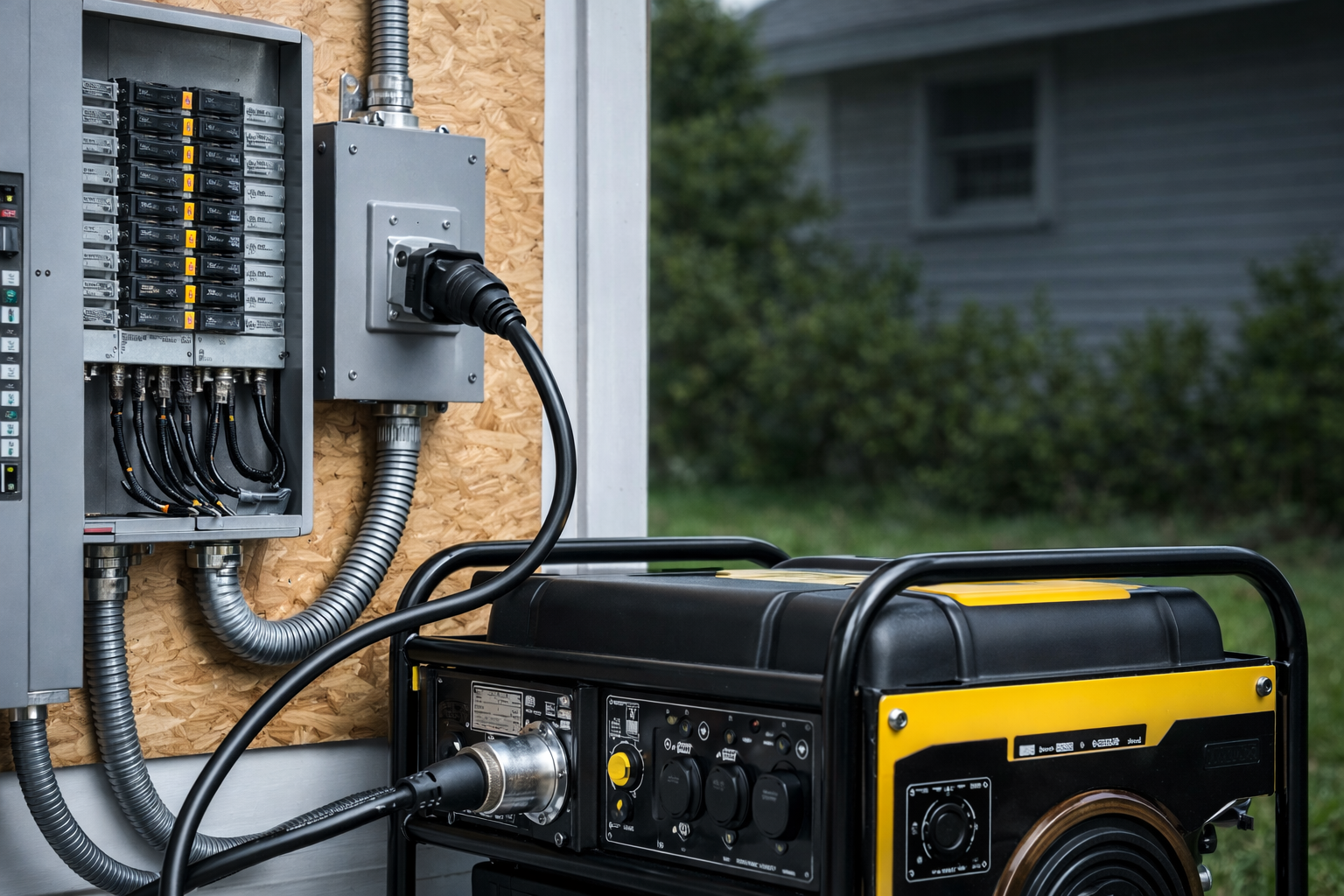
Transfer Switch Guide: How to Connect a Generator to Your Home Safely
A transfer switch is the critical safety component that allows a generator to power your home without creating dangerous backfeeding conditions. This transfer switch guide explains how generator transfer switches work, the different types available, and how to choose the correct setup for portable generators, standby generators, and solar backup systems.
Without a properly installed transfer switch, generator power can flow back into utility lines, damage appliances, and create serious safety hazards.
Understanding transfer switches is essential for safe generator integration and reliable home backup power.
👉 Top Recommended Generators & Gear
What Is a Generator Transfer Switch?
A generator transfer switch is a device that safely connects your generator to your home’s electrical panel while isolating it from the utility grid.
Its core function is simple but critical:
It ensures your home receives power from only one source at a time — either the utility or the generator.
This isolation prevents backfeeding and allows controlled power distribution during an outage.
Transfer switches are used with:
- Portable generators
- Whole house standby generators
- Solar battery backup systems
👉 See also: Generator Sizing Guide
👉 Return to: Home Backup Power Systems
Why a Transfer Switch Is Required for Generator Safety
Connecting a generator without a transfer switch is unsafe and often illegal.
Without proper isolation, generator power can:
- Backfeed into utility lines and endanger workers
- Damage your electrical panel
- Destroy appliances due to unstable voltage
- Create fire and shock hazards
Transfer switches eliminate these risks by physically isolating the utility connection.
👉 See: Generator Safety and Integration Guide
How a Generator Transfer Switch Works
During normal operation:
Utility Grid → Main Panel → Home Circuits
During an outage:
Generator → Transfer Switch → Home Circuits
Utility Grid → Disconnected
The transfer switch prevents both sources from supplying power at the same time.
This isolation is required for safe operation.
Types of Generator Transfer Switches
There are two main types used in home backup systems.
Manual Transfer Switch
Manual transfer switches require the homeowner to switch from utility power to generator power.
Common uses:
- Portable generators
- Essential circuit backup
Advantages:
- Lower cost
- Reliable mechanical operation
- Simple and effective solution
Manual transfer switches typically control selected circuits only.
👉 See: Portable Generator Guide
Automatic Transfer Switch (ATS)
Automatic transfer switches detect power loss and switch to generator power automatically.
Common uses:
- Whole house standby generators
- Permanent home backup systems
Advantages:
- Fully automatic operation
- No manual intervention required
- Fast power restoration
ATS systems are standard with standby generators.
👉 See: Automatic Transfer Switch Guide
Transfer Switch vs Interlock Kit
Both transfer switches and interlock kits provide safe generator integration, but they work differently.
Transfer switch:
- Dedicated switching device
- Controls selected circuits
- Easier load management
Interlock kit:
- Installed directly on main breaker panel
- Prevents main and generator breakers from running simultaneously
- Lower cost alternative
→ See: Transfer Switch vs Interlock Guide
Transfer Switch Sizing and Capacity
Transfer switch size must match generator output and intended load.
Common sizes include:
- 30 amp transfer switch → small portable generators
- 50 amp transfer switch → mid-size portable generators
- 100–200 amp transfer switch → whole house standby generators
Undersized transfer switches can overload and fail. Proper sizing ensures safe operation.
Transfer Switch Setup for Portable Generators
Portable generator systems typically connect using:
Generator → Inlet Box → Transfer Switch → Essential Circuits
This allows safe operation of critical loads such as:
- Refrigerator
- Sump pump
- Furnace blower
- Lighting circuits
- Internet and electronics
Transfer switches allow efficient use of limited generator capacity.
→ See: Portable Generator Sizing Guide
Transfer Switch Setup for Whole House Generators
Whole house standby generators use automatic transfer switches connected directly to the main panel.
System flow:
Generator → Automatic Transfer Switch → Main Panel → Home
This allows full or partial home backup depending on generator size.
→ See: Whole House Generator Guide
Transfer Switching for Solar and Battery Systems
Solar battery systems use integrated transfer switching to automatically switch between grid and battery power.
This ensures uninterrupted power during outages.
Generator Transfer Switch Installation Requirements
Transfer switches must be installed according to electrical code and manufacturer specifications.
Key requirements include:
- Proper breaker sizing
- Correct wiring and grounding
- Approved inlet box installation
- Proper generator connection method
Professional installation is recommended for safety and code compliance.
Common Transfer Switch Mistakes to Avoid
Avoid these common errors:
- Connecting generators without isolation
- Installing undersized transfer switches
- Improper breaker configuration
- Incorrect grounding
- Overloading connected circuits
Proper installation ensures safe and reliable operation.
Links to Our Power Guides
Link to:
- Generator Sizing Guide
- Portable Generator Guide
- Whole House Generator Guide
- Solar Generator Guide
- Generator Fuel Guide
- Main Home Backup Power Systems Hub
Transfer Switch Guide FAQ
Do I need a transfer switch to connect a generator to my home?
Yes. A transfer switch is the safest and most reliable way to connect a generator to your home’s electrical system. This transfer switch guide explains that without proper isolation, generator power can backfeed into utility lines, creating serious safety hazards and potentially violating electrical code.
A generator transfer switch ensures your home receives power from only one source at a time — either utility power or generator power — preventing dangerous electrical feedback and protecting your appliances and panel.
→ See: Generator Safety and Integration Guide
What does a transfer switch do for a generator?
A transfer switch safely connects your generator to your home while isolating it from the utility grid. Its primary function is to control the power source and prevent both utility and generator power from operating simultaneously.
During an outage, the transfer switch disconnects utility power and allows generator power to supply your home’s circuits safely. When utility power returns, the transfer switch restores normal operation.
This makes the transfer switch a critical safety component in any home backup power system.
What is the difference between a manual and automatic transfer switch?
A manual transfer switch requires the homeowner to physically switch from utility power to generator power during an outage. These are commonly used with portable generators and essential circuit backup.
An automatic transfer switch (ATS) detects outages automatically and switches to generator power without homeowner intervention. Automatic transfer switches are standard with whole house standby generators and provide seamless backup power.
→ See: Automatic Transfer Switch Guide
→ See: Portable Generator Guide
What size transfer switch do I need for my generator?
The correct transfer switch size depends on your generator’s amperage and power output.
Common transfer switch sizes include:
- 30 amp transfer switch → small portable generators
- 50 amp transfer switch → mid-size portable generators
- 100–200 amp transfer switch → whole house standby generators
The transfer switch must match or exceed the generator’s output capacity to prevent overload and ensure safe operation.
Is a transfer switch better than an interlock kit?
Both transfer switches and interlock kits provide safe generator integration, but they serve slightly different purposes.
Transfer switches use a dedicated switching device to control selected circuits and provide easier load management. Interlock kits use a mechanical lockout on the main breaker panel to prevent generator and utility power from operating simultaneously.
Transfer switches are often easier for homeowners to manage, while interlock kits are a lower-cost alternative when installed properly.
→ See: Transfer Switch vs Interlock Kit Guide