
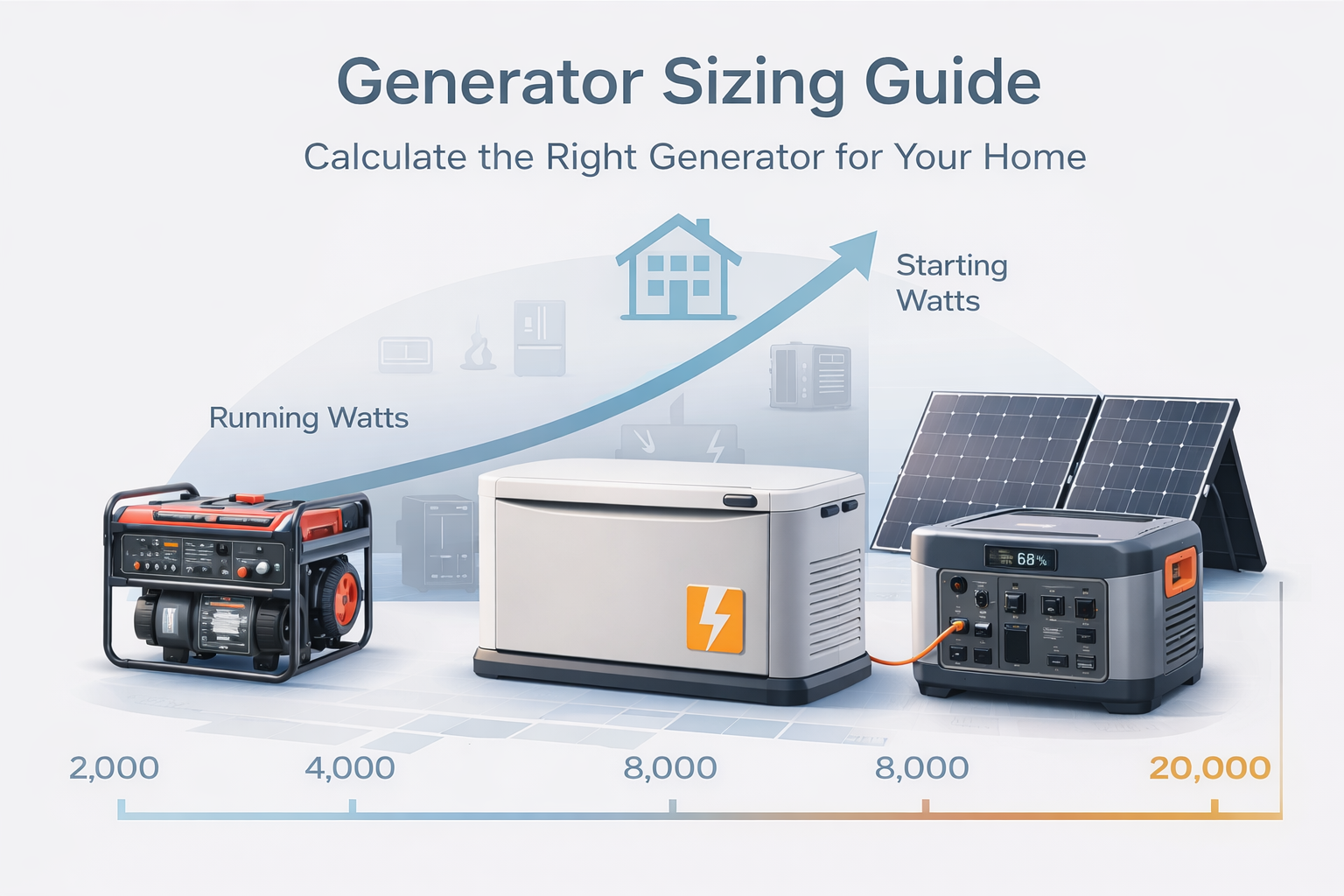
Generator Sizing Guide Introduction
A generator sizing guide helps you calculate the correct generator wattage for your home during a power outage. Most sizing mistakes happen when homeowners guess based on square footage or buy “the biggest generator they can afford” — instead of calculating running watts, starting (surge) watts, and simultaneous load.
This guide shows you how to size a generator step-by-step so you can choose the right solution — whether you’re using a portable generator, a whole house standby generator, or a solar generator (battery power station).
👉 Top Recommended Generators & Gear
Why Generator Sizing Matters
If a generator is undersized, it will overload, trip breakers, or fail to start critical appliances. If it’s oversized, you may waste fuel, pay more than necessary, and operate inefficiently.
Correct sizing prevents:
• overload shutdowns
• HVAC startup failure
• fuel waste
• unstable voltage under load
👉 See full breakdown: How many watts to run a house
Sizing is the foundation of every backup power system.
Running Watts vs Starting Watts
When sizing a generator, you need to understand two different power numbers: running watts and starting watts.
👉 See detailed guide: Running watts vs starting watts
Running Watts
Running watts (also called continuous watts) are the amount of electricity an appliance needs to operate normally after it’s already running.
For example:
- A refrigerator may use 700 running watts
- A sump pump may use 1,000 running watts
- A microwave may use 1,200 running watts
This is the steady power draw during normal operation.
Starting Watts (Surge Watts)
Starting watts (also called surge watts) are the temporary spike in power required when certain appliances first turn on — especially those with motors or compressors.
That surge usually lasts 1–3 seconds, but your generator must be able to handle it.
If it can’t:
- The generator may stall
- The breaker may trip
- The appliance may fail to start
👉 Learn the full explanation: Starting vs Running Watts Guide
What Are Surge Loads?
Surge loads are short bursts of extra power that certain appliances require when they first turn on. They are the #1 reason homeowners say, “My generator won’t start my fridge, pump, or AC.”
Even if a generator appears large enough based on running watts, it may fail if it cannot handle the brief startup spike.
👉 See detailed HVAC surge examples: AC Startup Surge Guide
Motor & Compressor Startup
Appliances with electric motors or compressors require more power at startup because they must overcome initial resistance.
When a motor first starts:
- It draws a high inrush current
- The compressor builds internal pressure
- The rotor accelerates from zero speed
This spike typically lasts 1–3 seconds, but it can require 2–3 times the running wattage.
Examples:
- Refrigerator: 700W running → ~2,000W surge
- Sump pump: 1,000W running → ~2,500W surge
- Central AC: 4,000W running → 7,000–9,000W surge
Once the appliance is running, the power demand drops back down to its normal operating level.
Why Breakers Trip
If your generator cannot supply the surge power:
- The generator may stall
- The overload protection may trip
- The breaker on the unit may shut off
- The appliance may fail to start at all
This often confuses homeowners because:
“It says 7,500 watts on the box — why won’t it start my AC?”
The answer is usually surge capacity, not running capacity.
Generator Surge Rating (Starting Watts)
Generators are rated with two important numbers:
- Running watts – continuous output
- Starting watts – maximum short-term surge output
The surge rating represents how much extra power the generator can supply briefly to handle motor startup.
Example:
- Generator rated at 7,500 running watts
- 9,500 starting watts
That means it can temporarily supply 9,500 watts for startup before settling back to 7,500 watts continuous.
If your appliance’s startup surge exceeds the generator’s starting watt rating, it will not start reliably.
Why Surge Planning Is Critical
When sizing a generator, you do NOT add all starting watts together. Instead:
- Add up your total running watts.
- Identify the appliance with the highest startup surge.
- Ensure your generator’s surge rating can handle that spike.
- Add a safety buffer (15–20%).
Ignoring surge loads is the most common generator sizing mistake.
If your generator struggles to start appliances, surge capacity — not total wattage — is usually the problem.
Notice the pattern:
Running watts tell you what it uses continuously.
Starting watts tell you whether your generator can start it at all.
The Most Common Sizing Mistake
Many homeowners add up only running watts and ignore surge.
Example:
If your refrigerator (700W) and sump pump (1,000W) are running at the same time, you might think you need 1,700 watts.
But if the sump pump kicks on and requires 2,500 starting watts, your generator must handle that surge — or it will trip.
That’s why proper generator sizing always accounts for:
Total running load + highest surge load (not all surges combined, just the largest simultaneous one).
→ Link: Starting vs Running Watts
Step-by-Step — How to Calculate Generator Size (Simple Method)
Simple Generator Sizing Formula
Here’s the easiest way to size a generator correctly:
Step 1
Add up the total running watts of everything you plan to operate at the same time.
Step 2
Find the appliance with the highest starting (surge) watts.
Step 3
Use this formula:
Where:
👉 Use the step-by-step: Generator Load Worksheet
Even Simpler Version (Homeowner Method)
Generator Size = Total Running Load + Largest Surge Spike
You only account for the biggest surge happening at one time — not every appliance’s surge combined.
Example
You want to run:
- Refrigerator → 700 running / 2,000 starting
- Sump pump → 1,000 running / 2,500 starting
- Lights → 600 running
Step 1: Add running watts
700 + 1,000 + 600 = 2,300 running watts
Step 2: Identify largest surge
Sump pump surge = 2,500 starting − 1,000 running = 1,500 surge difference
Step 3: Apply formula
2,300 running watts
- 1,500 surge difference
= 3,800 watts minimum generator size
Add 15–20% safety buffer:
3,800 × 1.2 ≈ 4,500–5,000 watt generator recommended
👉 Use the Appliance Wattage Chart & Calculator
👉 Use the Generator Load calculator guide
Common Appliance Wattage Chart (Quick Reference)
Kitchen Appliances
| Appliance | Running Watts | Starting Watts (Surge) |
|---|---|---|
| Refrigerator | 600–800 W | 1,800–2,500 W |
| Freezer | 500–700 W | 1,500–2,000 W |
| Microwave | 1,000–1,500 W | Same as running |
| Coffee Maker | 800–1,200 W | Same as running |
| Electric Stove Burner | 1,200–2,000 W | Same as running |
| Dishwasher | 1,200–1,500 W | 1,800–2,200 W |
👉 Refrigerator generator sizing guide
HVAC & Heating
| Appliance | Running Watts | Starting Watts (Surge) |
|---|---|---|
| Window AC (10k BTU) | 900–1,200 W | 2,000–3,000 W |
| Central AC (2–3 ton) | 3,000–5,000 W | 6,000–9,000+ W |
| Furnace Blower | 600–1,200 W | 1,500–2,500 W |
| Electric Space Heater | 1,500 W | Same as running |
| Heat Pump | 3,000–6,000 W | 6,000–10,000+ W |
Pumps & Water Systems
| Appliance | Running Watts | Starting Watts (Surge) |
|---|---|---|
| Sump Pump (1/3 HP) | 800–1,000 W | 2,000–2,500 W |
| Well Pump (1 HP) | 1,500–2,000 W | 3,000–4,000 W |
| Water Heater (Electric) | 4,000–5,500 W | Same as running |
| Septic Pump | 800–1,200 W | 2,000–3,000 W |
Lighting
| Appliance | Running Watts | Starting Watts |
|---|---|---|
| LED Bulb | 8–15 W | Same |
| CFL Bulb | 13–20 W | Same |
| Incandescent Bulb | 60–100 W | Same |
| Entire Lighting Circuit | 200–600 W | Same |
Lighting does not require surge capacity.
Medical & Electronics
| Appliance | Running Watts | Starting Watts |
|---|---|---|
| CPAP Machine | 30–60 W | Same |
| Oxygen Concentrator | 300–600 W | 600–1,000 W |
| Router / Modem | 10–25 W | Same |
| Laptop | 50–100 W | Same |
| TV (LED) | 100–300 W | Same |
| Desktop Computer | 300–600 W | Same |
Sensitive electronics benefit from inverter generators due to cleaner power output.
Generator Size Recommendations (Range Chart)
Generator Size Guide by Common Use (Quick Mapping)
This quick reference shows what different generator sizes can realistically power during an outage. Actual capacity depends on surge loads, appliance efficiency, and how many devices run simultaneously.
👉 See real-world examples: How many watts to run a house
Generator Sizing by Home Size
👉 What size generator for 2500 sq ft house
🔹 2,000–3,500 Watts — Small Essentials Backup
Best for minimal, critical loads and short outages.
Typically supports:
- Refrigerator or freezer
- Internet modem and router
- Phone and device charging
- Several LED lights
- TV or laptop
Common use case:
Apartment backup, emergency refrigeration protection, or minimal home essentials.
Limitations:
Cannot run sump pumps reliably, HVAC, or multiple motor loads at once.
🔹 5,000–7,500 Watts — Essential Circuit Backup (Most Homes)
This is the most common portable generator range for homeowners.
Typically supports:
- Refrigerator and freezer
- Sump pump or well pump
- Lighting circuits
- Internet and electronics
- Microwave and small kitchen appliances
- Furnace blower
May support (depending on surge capacity):
- Window AC units
- Small central AC with soft-start
Common use case:
Essential circuit backup using a transfer switch or interlock.
🔹 9,000–12,000 Watts — Heavy Portable Backup + Limited HVAC
High-capacity portable generators provide significantly more flexibility.
Typically supports:
- All essential circuits
- Well pump
- Multiple kitchen appliances
- Larger pump loads
- Some central air conditioning systems (depending on tonnage and surge)
Common use case:
Larger homes needing stronger portable backup without installing a standby system.
Limitations:
Still requires manual startup and fuel management.
🔹 14–24 kW — Whole House Standby Generator Range
This is the typical size range for permanently installed standby generators.
Typically supports:
- Full home electrical panel (properly sized systems)
- Central air conditioning
- Electric appliances
- Well pumps
- Heating systems
- Continuous whole-home operation
Common use case:
Automatic backup for entire homes with seamless transfer during outages.
These systems start automatically and can run continuously with natural gas or propane.
🔹 Solar Generator / Battery Systems — Sized Differently
Battery backup systems are sized using two separate specifications:
- Inverter output (watts) → determines what appliances can run
- Battery capacity (watt-hours or kWh) → determines how long they run
Example:
- 2,000W inverter → can run refrigerator and electronics
- 2 kWh battery → can run a 1,000W load for about 2 hours
Whole-home battery backup requires large storage capacity and proper system integration.
Quick Summary Table
| Generator Size | Typical Use Case |
|---|---|
| 2,000–3,500 W | Refrigerator, lights, electronics |
| 5,000–7,500 W | Essential circuits, sump pump, furnace |
| 9,000–12,000 W | Larger loads, some HVAC |
| 14–24 kW | Whole-home standby generator |
| Solar/Battery | Essential circuits, runtime depends on battery size |
Size-specific guides:
→ 3500W Guide
→ 5000W Guide
→ 7500W Guide
→ 10,000W Guide
→ 20kW Standby Guide
Sizing for Portable Generators
Portable sizing needs:
• higher surge headroom
• load management
• runtime considerations
• transfer switch / cords approach
→ Portable Generators for Home Backup
Sizing for Whole House Generators
Standby sizing needs:
• HVAC startup planning
• whole-home vs essential circuits
• ATS integration
• fuel supply sizing (NG/propane)
→ Whole House Generators Guide
Sizing for Solar Generators (Battery + Inverter)
Battery capacity (Wh/kWh) = runtime
Inverter watts (running + surge) = what it can start/power
→ Solar Generators for Home Backup
Transfer Switch + Load Management Considerations
Generator sizing can vary significantly depending on how your home is connected to backup power. Homes using a whole panel connection with an interlock kit typically require a larger generator because the entire electrical panel is available, increasing the potential load. In contrast, a transfer switch connected to selected circuits allows you to limit power to essential systems like the refrigerator, furnace, and lighting, which reduces the total wattage required and allows for a smaller, more efficient generator.
You can also reduce generator size requirements by staggering appliance usage, meaning you avoid running high-wattage appliances at the same time. Another effective approach is installing a critical loads subpanel, which isolates only the most important circuits for backup power. This setup improves efficiency, reduces generator strain, and allows you to safely power essential systems with a properly sized generator instead of overspending on unnecessary capacity.
→ Link: Transfer Switch Silo
→ Link: Interlock vs Transfer Switch
→ Link: Automatic Transfer Switch Guide
👉 See safe wire sizing: Extension Cord Gauge Chart
Common Generator Sizing Mistakes to Avoid
Choosing the wrong generator size is one of the most common causes of overloads, startup failures, and poor runtime during outages. These mistakes often result in generators that look sufficient on paper but fail under real-world conditions.
Using Square Footage Only
Home size alone does not determine generator requirements. Two homes with the same square footage can have very different electrical loads depending on HVAC type, well pumps, electric appliances, and heating systems.
Generator sizing must be based on actual appliance wattage, not home size.
👉See: Generator Load Calculation Guide
Ignoring Surge Watts
Many appliances require significantly more power during startup than during normal operation. If surge watts are not accounted for, the generator may:
- Stall during startup
- Trip its overload protection
- Fail to start compressors or pumps
Always size the generator to handle the largest surge load, not just running watts.
Forgetting Well Pumps or Sump Pumps
Well pumps and sump pumps are critical during outages but are often overlooked in sizing calculations.
These pumps typically have:
- Moderate running watts
- Very high starting surge
If not properly accounted for, the generator may not be able to start the pump when needed most.
👉 See exact sizing: What size generator for a well pump
👉 See exact sizing: What size generator for a sump pump
Trying to Run Central AC Without a Soft Start
Central air conditioning systems have some of the highest surge loads in a home. Many portable generators cannot start AC compressors without a soft-start device.
Without proper surge planning, the generator may overload or fail to start the AC entirely.
Soft-start devices can significantly reduce startup surge and improve compatibility.
👉 See central AC surge sizing: AC Startup Surge Guide
Running at 100% Load Constantly
Operating a generator continuously at its maximum rated capacity reduces efficiency, shortens engine life, and increases overload risk.
Generators perform best when operating at approximately 50–70% of rated capacity, which allows surge headroom and improves long-term reliability.
Ignoring Fuel and Runtime Planning
Generator runtime depends on fuel availability, load level, and efficiency. Undersized fuel planning can result in the generator shutting down during extended outages.
Important considerations include:
- Fuel tank size
- Expected runtime at typical load
- Refueling availability during outages
- Load level and fuel consumption rate
Proper sizing includes planning for both power capacity and realistic runtime.
→ See: Generator Fuel and Runtime Guide
Frequently Asked Questions About Generator Sizing
What size generator do I need to run my house?
The generator size you need depends on how much of your home you want to power during an outage.
For essential circuit backup (refrigerator, sump pump, lights, internet), most homes require 5,000–7,500 running watts. Homes that want to run larger loads like well pumps or small HVAC systems may need 8,000–12,000 watts or more.
To size a generator correctly:
- List the appliances you want to run
- Add their running watts
- Identify the highest starting (surge) watt appliance
- Add a 15–20% safety buffer
Avoid sizing based on square footage alone. Accurate generator sizing requires real load calculation.
👉 See: How Many Watts to Run a House
👉 See: Generator Sizing Guide (Full Walkthrough)
Can a 7500W generator run central AC?
It depends on the size of the air conditioning unit and its startup surge requirements.
A 7,500-watt generator may run:
- Smaller 2–3 ton AC units (in some cases)
- Systems equipped with a soft-start device
- Partial HVAC loads
However, many central air systems require very high startup surge — sometimes 2–3 times their running wattage. A 3–5 ton AC unit often exceeds what a typical 7,500W portable generator can safely handle.
Always calculate both:
- Running watts
- Starting (surge) watts of the compressor
Without proper sizing, the generator may stall, trip breakers, or fail to start the AC.
👉 Air Conditioning generator sizing guide
👉 See: Surge Watts Explained
What’s the difference between watts and kW?
Watts (W) and kilowatts (kW) measure electrical power.
- 1 kilowatt (kW) = 1,000 watts
- A 7.5 kW generator = 7,500 watts
- A 20 kW standby generator = 20,000 watts
Portable generators are usually rated in watts, while whole house standby generators are typically rated in kilowatts (kW).
Understanding this conversion is critical when comparing portable vs standby systems.
→ See: kW to Watts Conversion Guide
→ See: Whole House Generator Sizing
How do I size a generator for a well pump?
Well pumps require careful generator sizing because they have high startup surge.
Most residential well pumps:
- Run between 700–1,500 watts
- Surge to 2,000–4,000+ watts at startup
To size a generator for a well pump:
- Identify pump horsepower (HP)
- Check the manufacturer’s starting watt requirement
- Ensure generator surge rating exceeds pump startup
- Account for any other appliances running simultaneously
Undersized generators often fail to start well pumps due to insufficient surge capacity — even if the running watts appear adequate.
👉 See: Generator Size for Well Pump
👉 See: Running vs Starting Watts Explained
How do I size a solar generator?
Sizing a solar generator requires understanding two separate numbers:
- Battery capacity (Wh or kWh) – determines runtime
- Inverter output (watts + surge rating) – determines what it can power
For example:
- A 2,000W inverter can power appliances totaling up to 2,000 running watts.
- A 2 kWh battery can run a 1,000W load for roughly 2 hours.
To size a solar generator:
- Calculate total running watts
- Confirm inverter surge rating supports motor startup
- Determine how long you need the system to run
- Factor in solar recharge capacity (if applicable)
Many homeowners focus only on battery size — but inverter output is just as important.
→ See: Solar Generator Sizing Guide
→ See: Battery Capacity vs Inverter Output Explained
Generator Sizing Guides
👉 Generator sizing chart
👉 How many watts to run a house
👉 What size generator for 2000 sq ft house
👉 What size generator for central air conditioner
👉 Running watts vs starting watts guide
👉 Generator load calculator guide
👉 Starting vs running watts guide
👉 AC startup surge guide
👉 Generator load worksheet & calculator
👉 Appliance wattage chart & calculator
👉 Extension cord gauge chart & calculator
Next: Choose the Right Backup System Type
→ Portable Generators for Home Backup
→ Whole House Generators
→ Solar Generators for Home Backup
→ Transfer Switch & Integration Guide
→ Fuel & Runtime Guide
→ Home Backup Power Systems Hub