
Generator Load Worksheet (Free Chart + Calculator)
Before choosing a generator, you need to know exactly how much power your appliances require. This generator load worksheet helps you calculate total running watts, account for starting surge, and determine the correct generator size with a built-in calculator and printable chart.
Instead of guessing — and risking overloads, tripped breakers, or buying the wrong generator — use this worksheet to total your essential loads and size your backup power system correctly the first time.
Generator Load Worksheet: How to Calculate Your Power Needs
Before buying or running a generator, you need to know exactly how much power your appliances require. A generator load worksheet helps you total your running watts, estimate peak load, and choose the correct generator size.
Many homeowners guess — and that leads to:
- Overloaded generators
- Tripped breakers
- Equipment damage
- Wasted fuel
- Buying the wrong generator size
This guide includes:
✔ A printable generator load chart
✔ A step-by-step load calculation method
✔ A built-in load calculator
✔ Generator sizing recommendations
Step 1: List Your Essential Appliances
Start with only the appliances you plan to run during an outage.
Common essentials:
- Refrigerator
- Freezer
- Sump pump
- Furnace blower
- Lights
- Wi-Fi + modem
- Microwave
- Medical devices
Avoid adding everything unless you’re sizing for whole-house coverage.
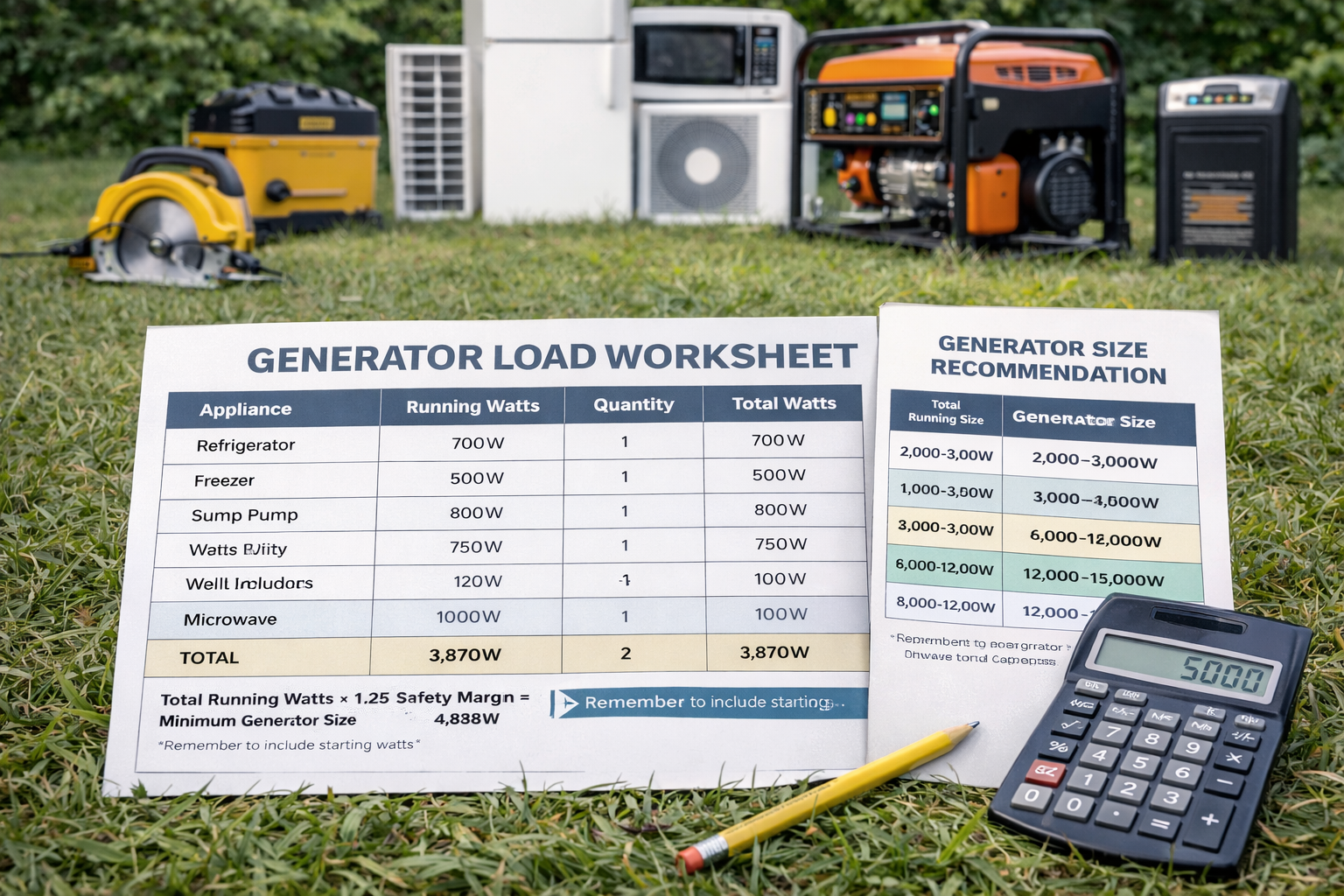
Generator Load Worksheet (Fillable Chart)
Use this worksheet to calculate your total running watts.
| Appliance | Running Watts | Quantity | Total Watts |
|---|---|---|---|
| Refrigerator | 700W | 1 | 700W |
| Freezer | 500W | 1 | 500W |
| Sump Pump | 800W | 1 | 800W |
| Lights (LED) | 120W | 1 | 120W |
| Wi-Fi + Modem | 25W | 1 | 25W |
| TOTAL | 2,145W |
Step 2: Add Starting (Surge) Watts
Some appliances require extra power when starting:
- Refrigerators
- Air conditioners
- Well pumps
- Sump pumps
Surge watts are typically 2–3x running watts.
Example:
Refrigerator
Running: 700W
Starting: 2,100W
Your generator must handle the highest starting load at any given time.
Generator Load Calculator
| Appliance | Watts | Qty |
|---|---|---|
Step 3: Choose Generator Size
Use this sizing buffer:
Total Running Watts × 1.25 safety margin
Example:
2,145W × 1.25 = 2,681W
Choose at least a 3,000W generator.
If running multiple motor loads, increase margin to 30–40%.
Generator Load Recommendations Chart
| Total Running Watts | Recommended Generator Size |
|---|---|
| 2,000–3,000W | 3,000–3,500W |
| 3,000–5,000W | 5,000–6,500W |
| 5,000–8,000W | 7,500–10,000W |
| 8,000–12,000W | 12,000–15,000W |
Common Generator Load Calculation Mistakes
❌ Ignoring starting watts
❌ Adding every appliance in the house
❌ Forgetting well pumps
❌ No safety margin
❌ Undersized extension cords
Links To Related Guides
- How Many Watts to Run a House
- Generator Fuel Consumption Calculator
- Starting vs Running Watts Guide
- Extension Cord Gauge Chart
FAQ: Generator Load Worksheet
How do I calculate generator load?
Add all running watts of appliances you plan to run. Then account for starting surge and add a safety margin of 20–30%.
What is a generator load worksheet?
It’s a chart used to total appliance wattage so you can choose the correct generator size.
Should I use running or starting watts?
Use running watts for total load and ensure generator starting watt capacity handles motor surge.
How much extra capacity should a generator have?
At least 20–25% more than total running watts. More if multiple motors start simultaneously.
Final Thoughts
A generator load worksheet prevents costly mistakes and ensures your backup power system is:
- Properly sized
- Fuel efficient
- Safe
- Reliable
If you're building a complete backup system, use this worksheet along with:
- Generator sizing guides
- Fuel runtime calculator
- Voltage drop calculator
- Extension cord gauge chart