
Starting vs Running Watts Explained (Generator Guide)
When choosing a generator, understanding the difference between starting watts vs running watts is critical. Many appliances require extra power the moment they turn on — especially anything with a motor or compressor. If your generator isn’t sized to handle that surge, it can overload, trip breakers, or fail to start essential equipment like refrigerators, sump pumps, or air conditioners.
This guide explains exactly what starting watts and running watts mean, why surge power matters, and how to calculate the correct generator size for your home. You’ll also find a practical calculator and real-world examples to help you plan your backup power system safely and efficiently.
Starting vs Running Watts: Why It Matters
When choosing a generator, one of the most important — and misunderstood — concepts is the difference between starting watts vs running watts.
Many appliances require extra power when they first turn on. If your generator can’t handle that surge, it may:
- Trip a breaker
- Stall
- Shut down
- Fail to start the appliance
Understanding this difference ensures you size your generator correctly the first time.
What Are Running Watts?
Running watts (also called rated watts) are the continuous power an appliance needs to operate normally.
Example:
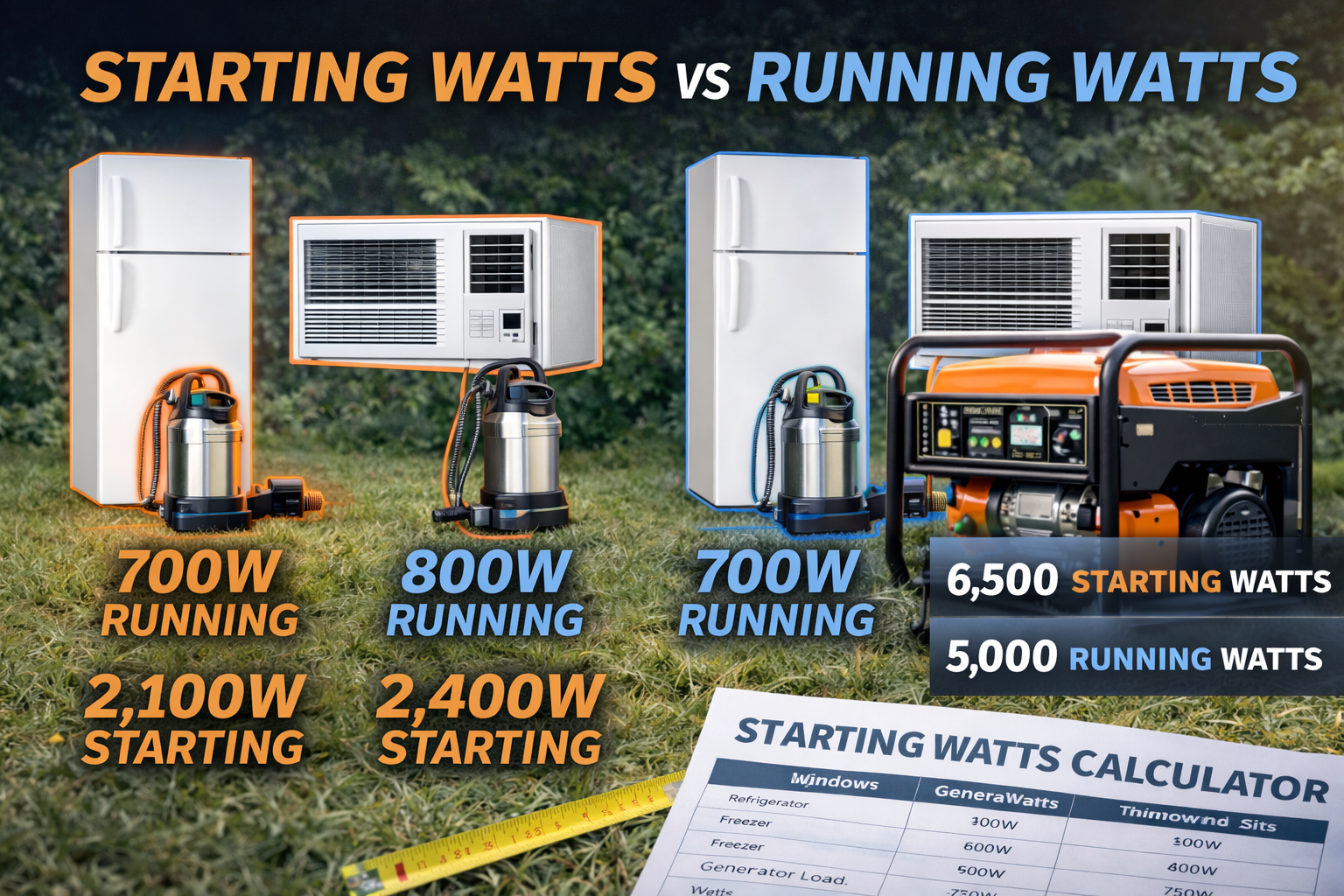
- Refrigerator running: 700 watts
- Sump pump running: 800 watts
- Microwave running: 1,000 watts
Running watts determine your base load.
This is what your Generator Load Worksheet is primarily calculating.
What Are Starting Watts?
Starting watts (also called surge watts) are the extra power required for a few seconds when a motor first starts.
Motor-driven appliances require 2–3x their running wattage during startup.
Examples:
| Appliance | Running Watts | Starting Watts |
|---|---|---|
| Refrigerator | 700W | 2,100W |
| Sump Pump | 800W | 2,400W |
| Window AC | 1,000W | 3,000W |
| Well Pump | 1,200W | 3,600W |
This surge only lasts a few seconds — but your generator must handle it.
Why Generators List Two Watt Ratings
Most generators display:
- Running watts (continuous output)
- Starting watts (maximum surge capacity)
Example:
Generator Rating:
- 5,000 running watts
- 6,500 starting watts
This means:
- It can continuously power up to 5,000 watts
- It can temporarily handle 6,500 watts during startup
If your appliance startup surge exceeds the generator’s surge capacity, it will fail to start.
How to Calculate Generator Wattage Correctly
Follow this method:
Step 1: Add All Running Watts
Use your worksheet to total running loads.
Example:
Refrigerator – 700W
Freezer – 500W
Lights – 200W
Wi-Fi – 25W
Total running watts = 1,425W
Step 2: Identify Largest Surge Load
Find the appliance with the highest starting watts.
Example:
Refrigerator surge = 2,100W
Step 3: Compare to Generator Ratings
Your generator must:
- Handle total running watts
- Have enough surge capacity for the largest motor starting
If multiple motors may start simultaneously, increase margin.
Starting Watts Calculator (Generator Surge Estimator)
Starting Watts Calculator (Surge Watts)
Appliances
| Appliance | Running Watts | Qty | Surge Multiplier | Starting Watts |
|---|
Results
The Most Common Generator Sizing Mistake
People add up running watts but ignore starting watts.
Result?
Generator runs fine… until refrigerator kicks on.
Then:
- Lights dim
- Generator struggles
- Breaker trips
This is why surge planning is critical.
Starting Watts and Fuel Consumption
Higher surge loads also impact fuel burn.
If your generator frequently operates near maximum capacity, fuel usage increases.
Understanding both load and runtime ensures proper planning.
Starting vs Running Watts Example Scenario
Let’s say you have:
- Refrigerator (700W running / 2,100W starting)
- Sump pump (800W running / 2,400W starting)
- Lights (200W)
Running total = 1,700W
But if the sump pump and refrigerator start at the same time:
2,100W + 2,400W = 4,500W surge
Your generator must handle that momentary demand.
A 3,500W generator would fail in this scenario.
How to Reduce Starting Watt Problems
✔ Stagger appliance startup
✔ Use soft-start kits for AC units
✔ Choose inverter generators for sensitive electronics
✔ Oversize generator by 20–30%
Starting vs Running Watts FAQ
What is the difference between starting and running watts?
Running watts are continuous power needs. Starting watts are temporary surge power required when a motor first turns on.
How many starting watts does a refrigerator need?
Most refrigerators require 2–3 times their running wattage during startup.
Do LED lights have starting watts?
No. LED lights do not have motor surge and require minimal startup power.
Can I ignore starting watts?
No. Ignoring surge loads is one of the main reasons generators overload.
Does starting wattage affect fuel usage?
Indirectly. Higher load levels increase fuel consumption, especially when near maximum output.
Links To Related Articles
- Generator Load Worksheet
- How Many Watts to Run a House
- Generator Fuel Consumption Calculator
- Extension Cord Gauge Chart and Calculator
Final Thoughts
Understanding starting vs running watts prevents:
- Generator overload
- Appliance damage
- Fuel waste
- Buying the wrong generator size
When sizing a generator:
- Add running watts
- Identify largest surge load
- Add safety margin
- Verify surge capacity
Doing this ensures safe and reliable backup power.