
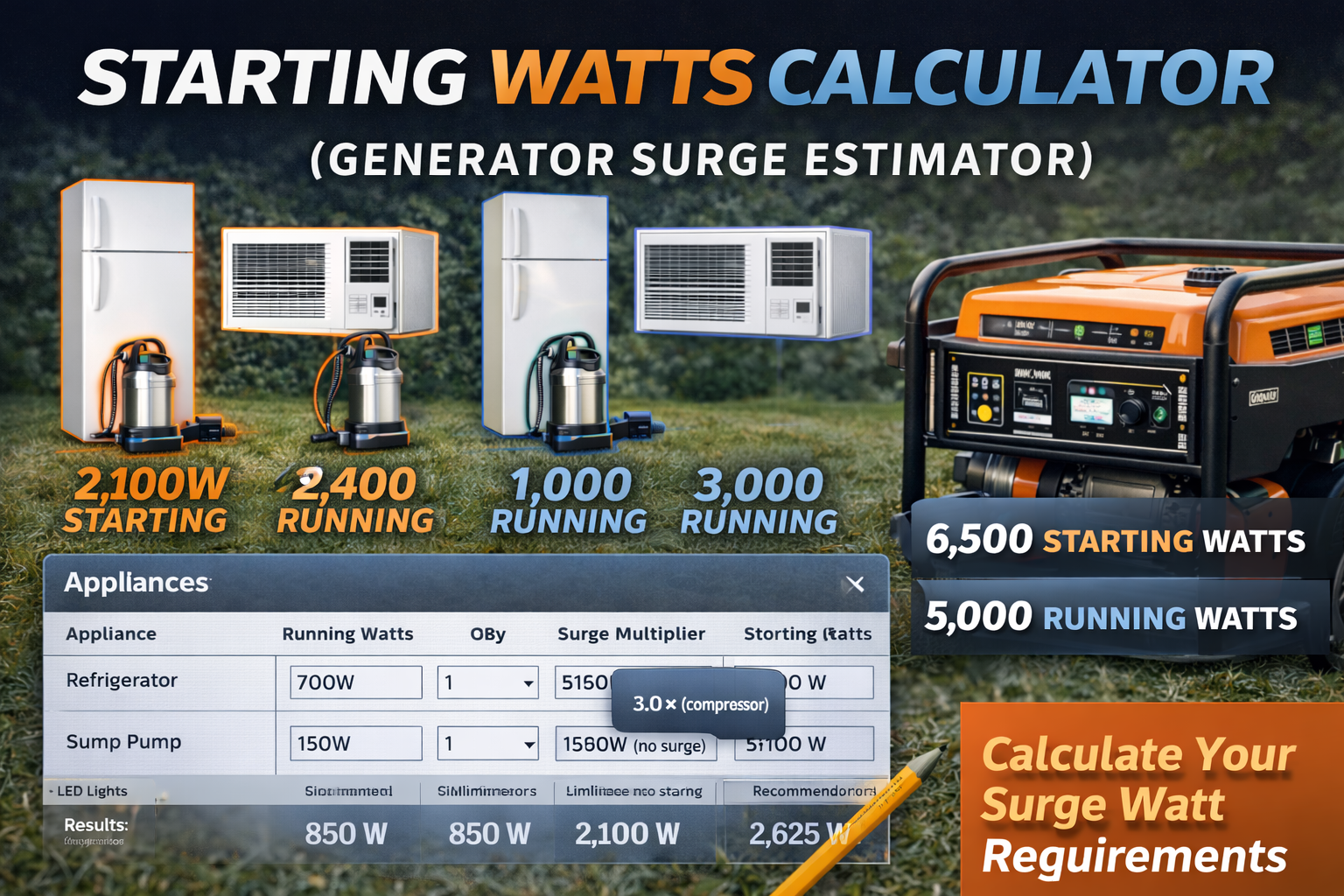
Starting Watts Calculator: Estimate Generator Surge Requirements
When sizing a generator, one of the biggest mistakes homeowners make is ignoring starting watts — also called surge watts.
Motor-driven appliances require significantly more power during startup than they do while running. If your generator can’t handle that temporary surge, it may overload, stall, or fail to start essential equipment.
Use the calculator below to estimate:
- Total running watts
- Highest starting watt requirement
- Simultaneous motor startup load
- Recommended generator size with safety margin
This tool works alongside our full Generator Planning Guide and load worksheet.
Starting Watts Calculator (Generator Surge Estimator)
👉 Use the interactive calculator below to estimate your surge requirements.
Starting Watts Calculator (Generator Surge Estimator)
Appliances
| Appliance | Running Watts | Qty | Surge Multiplier | Starting Watts |
|---|
Results
What Are Starting Watts?
Starting watts are the extra power required for a few seconds when a motor first turns on.
Appliances that require surge power include:
- Refrigerators
- Freezers
- Sump pumps
- Well pumps
- Air conditioners
- Furnace blowers
In most cases, starting watts are 2–3 times higher than running watts.
Example:
| Appliance | Running Watts | Starting Watts |
|---|---|---|
| Refrigerator | 700W | 2,100W |
| Sump Pump | 800W | 2,400W |
| Window AC | 1,000W | 3,000W |
Learn more here:
👉 Starting vs Running Watts Explained
Why Surge Planning Is Critical
If your generator only matches your running watts, you risk:
- Breaker trips
- Generator overload
- Compressor startup failure
- Flickering lights
- Reduced appliance lifespan
Your generator must handle:
- Total running load
- Largest motor surge load
- Worst-case simultaneous startup
This calculator helps you model those scenarios.
How to Use the Starting Watts Calculator
Step 1: Add Your Appliances
Enter running watts and quantity.
Step 2: Select Surge Multiplier
- Motors: 2–3×
- Compressors: ~3×
- Resistive loads (heaters, lights): 1×
Step 3: Choose Simultaneous Startup Assumption
Most homes assume 1 motor starts at a time.
For conservative planning, choose 2.
Step 4: Add Safety Margin
We recommend at least 20–25%.
Example Scenario
Appliances:
- Refrigerator (700W × 3)
- Sump pump (800W × 3)
- Lights (200W × 1)
Running total = 1,700W
Largest starting = 2,400W
If two motors start at once = 4,500W surge
Recommended generator size (25% margin):
~5,600W
A 3,500W generator would fail in this scenario.
Next Step: Complete Your Full Generator Plan
After estimating surge load:
1️⃣ Use the Generator Load Worksheet to total running watts
2️⃣ Verify generator runtime using the Generator Fuel Consumption Calculator
3️⃣ Confirm proper wire size with the Extension Cord Gauge Chart
All tools are part of our main:
Frequently Asked Questions
How many starting watts does a refrigerator need?
Most refrigerators require 2–3 times their running wattage during startup.
Can I ignore starting watts when buying a generator?
No. Ignoring surge load is one of the most common generator sizing mistakes.
What if two motors start at the same time?
Your generator must handle the combined surge. The calculator allows you to model this scenario.
Are starting watts higher for inverter generators?
Inverter generators still must meet surge demand, but they regulate power more efficiently.
How much extra capacity should I add?
We recommend at least 20–25% above your highest estimated surge requirement.
Links To Related Articles
- Generator Sizing Hub
- Starting vs Running Watts Guide
- Generator Load Worksheet & Calcuator
- Generator Fuel Consumption Calculator
- Extension Cord Gauge Chart & Calculator
Final Thoughts
The difference between a generator that runs smoothly during an outage and one that constantly trips often comes down to surge planning.
By calculating starting watts properly, you:
- Prevent overload
- Protect appliances
- Improve fuel efficiency
- Choose the correct generator size
Use the calculator above, then continue your planning with the full generator sizing guide.