
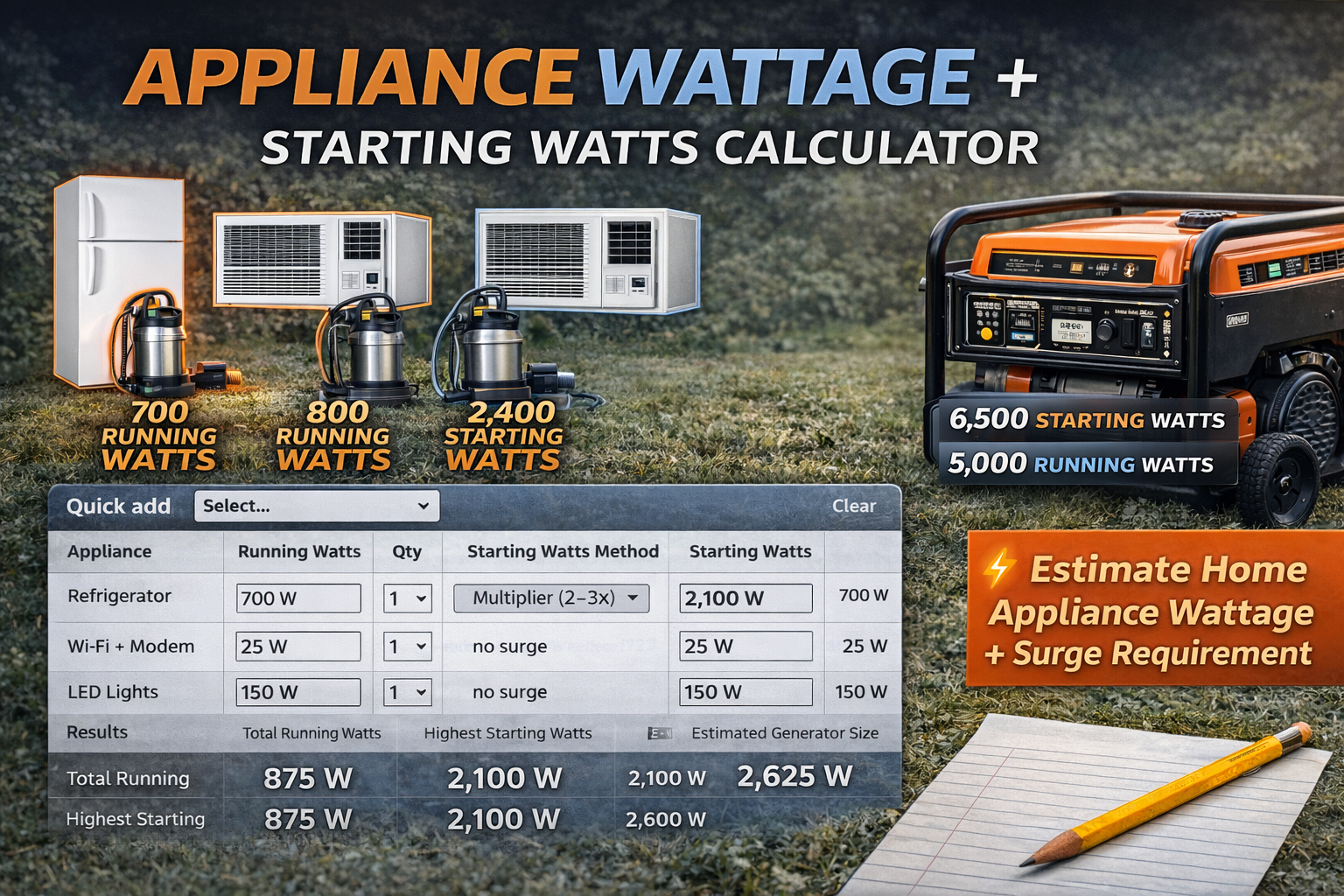
Appliance Wattage Chart: Estimate Power Requirements
Before choosing a generator, extension cord, or backup power system, you need to know how many watts your appliances use. This appliance wattage chart provides estimated running and starting watts for common household devices so you can calculate your total load accurately.
Many people underestimate appliance power requirements — especially motor-driven equipment — which leads to:
- Generator overload
- Breaker trips
- Startup failures
- Undersized wiring
Use the chart below as a starting point, then verify using appliance labels when possible.
Common Household Appliance Wattage Chart
Kitchen Appliances
| Appliance | Running Watts | Starting Watts |
|---|---|---|
| Refrigerator | 600–800W | 1,800–2,400W |
| Freezer | 400–700W | 1,200–2,100W |
| Microwave | 800–1,200W | Same as running |
| Coffee Maker | 600–900W | Same as running |
| Dishwasher | 1,200–1,500W | 1,800W |
| Electric Stove (per burner) | 1,200–1,500W | Same |
Heating & Cooling
| Appliance | Running Watts | Starting Watts |
|---|---|---|
| Window AC | 900–1,500W | 2,700–4,500W |
| Central AC (3–4 ton) | 3,000–5,000W | 6,000–12,000W |
| Furnace Blower | 500–800W | 1,200–2,000W |
| Space Heater | 1,500W | Same |
Water & Pumps
| Appliance | Running Watts | Starting Watts |
|---|---|---|
| Sump Pump | 700–1,000W | 2,100–3,000W |
| Well Pump (½ HP) | 1,000–1,500W | 3,000–4,500W |
| Water Heater (Electric) | 3,000–4,500W | Same |
Lighting & Electronics
| Appliance | Running Watts | Starting Watts |
|---|---|---|
| LED Light Bulb | 8–15W | Same |
| LED Lights (10 bulbs) | 80–150W | Same |
| TV (LED) | 80–200W | Same |
| Wi-Fi + Modem | 20–40W | Same |
| Desktop Computer | 300–600W | Same |
Why Starting Watts Matter
Motor-driven appliances require additional surge power during startup.
Learn more here:
👉 Starting vs Running Watts Guide
👉 Starting Watts Calculator (Generator Surge Estimator)
If your generator can’t handle surge loads, appliances may fail to start.
Appliance Wattage Calculator
Use this calculator to total your running watts.
Appliance Wattage + Starting Watts Calculator
Appliances
| Appliance | Running Watts | Qty | Starting Watts Method | Starting Watts | Row Running Total |
|---|
Results
How to Use This Wattage Chart for Generator Sizing
Step 1: Add Running Watts
Use the calculator above or the Generator Load Worksheet.
Step 2: Account for Starting Watts
Use the Starting Watts Calculator to estimate surge load.
Step 3: Add Safety Margin
Increase total by 20–30%.
Step 4: Verify Runtime
Use the Generator Fuel Consumption Calculator to estimate fuel usage.
Links To Related Articles
- Generator Sizing Hub Page
- Starting vs Running Watts
- Starting Watts Calculator
- Generator Load Worksheet
- Generator Fuel Consumption Calculator
- Extension Cord Gauge Chart
FAQ – Appliance Wattage Chart
How many watts does a refrigerator use?
Most refrigerators use 600–800 running watts and up to 2,400 starting watts.
Do LED lights have starting watts?
No significant surge. Starting watts are typically the same as running watts.
How do I find exact appliance wattage?
Check the label on the appliance or owner’s manual. If only amps are listed:
Watts = Volts × Amps
What appliances use the most watts in a home?
Central AC, electric water heaters, electric stoves, and well pumps are typically the highest load appliances.
Can I run all appliances at once on a generator?
Only if the generator is sized to handle both running and starting loads.
Final Thoughts
An accurate appliance wattage chart is the foundation of proper generator sizing.
By combining:
- Appliance watt totals
- Starting watt calculations
- Safety margin
- Fuel planning
You can build a safe and reliable backup power system.