
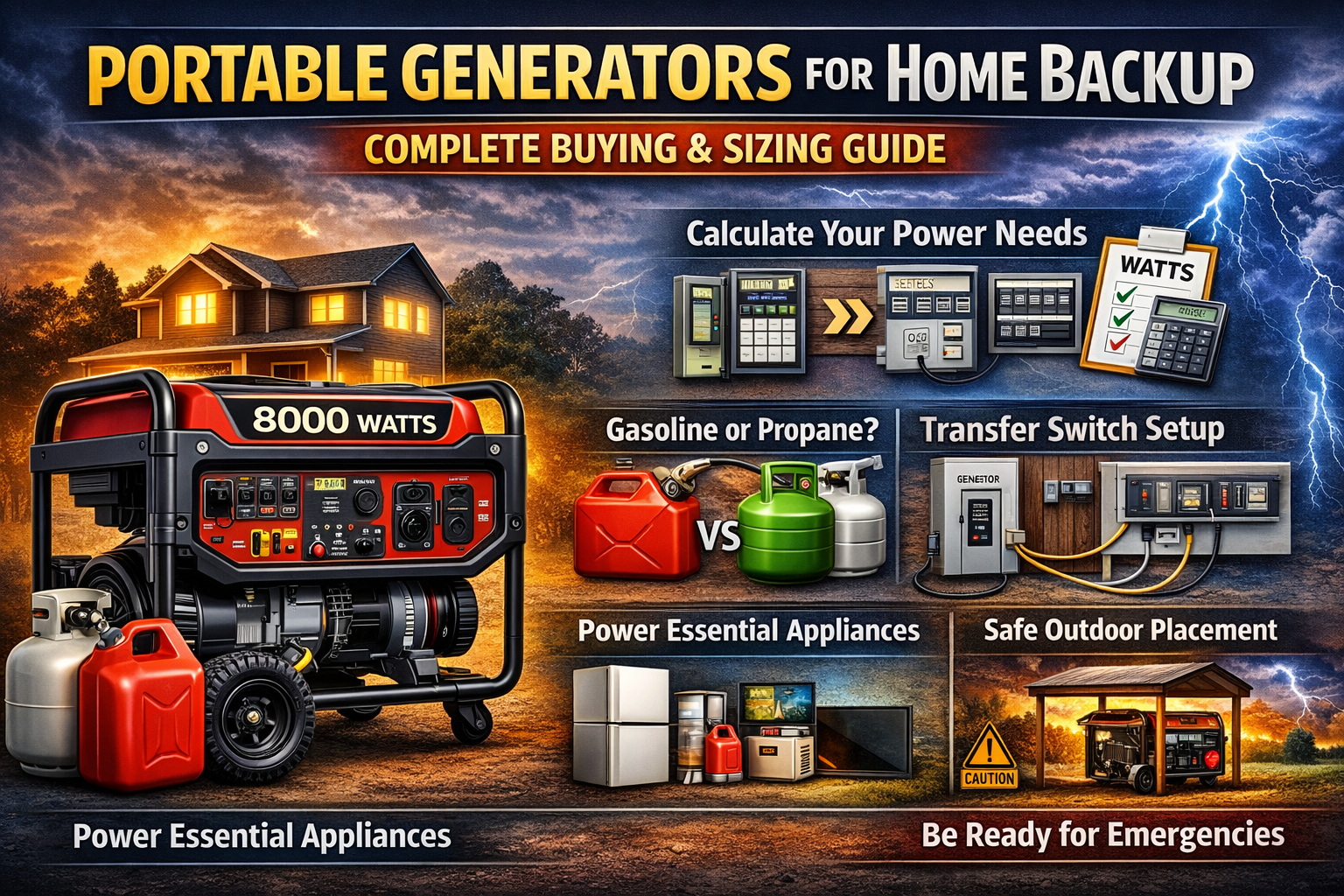
Introduction to Portable Generators for Home Backup
Portable generators for home backup are one of the most practical and cost-effective ways to protect your home during a power outage. Whether caused by storms, grid failures, or extreme weather, outages can disrupt refrigeration, sump pumps, heating systems, and essential electronics.
A properly sized portable generator can keep critical appliances running and prevent damage — without the installation cost of a whole house standby generator.
However, choosing the right portable generator for home backup isn’t just about buying the highest wattage model available.
You need to understand:
• Running watts vs starting (surge) watts
• How appliance startup loads affect generator sizing
• Fuel type options (gasoline, propane, dual fuel)
• Runtime at different load percentages
• Safe transfer switch or interlock connection
• Proper outdoor placement and carbon monoxide safety
This guide explains how portable generators work, how to calculate your home’s power needs, and how to safely connect a portable generator to your house — so your backup system performs reliably when you need it most.
👉 Top Recommended Generators & Gear
–
Who Should Choose a Portable Generator for Home Backup?
A portable generator is ideal for homeowners who need temporary or essential backup power without permanent installation.
Best suited for:
• Short-to-mid duration power outages
• Budget-conscious homeowners
• Essential circuit coverage (refrigeration, sump pump, lighting, internet)
• Flexible use (home, RV, jobsite)
• Seasonal storm preparation
Not ideal for:
• Fully automatic whole-home power
• Large HVAC-heavy homes
• Extended outages without reliable fuel access
• Homeowners wanting seamless automatic startup
Understanding these limitations ensures you choose the right backup power solution for your outage risk and load requirements.
What Can a Portable Generator Run During a Power Outage?
Many homeowners either overestimate or underestimate what a portable generator can power.
Most portable generators can run:
• Refrigerators and freezers
• Sump pumps and well pumps
• Lighting circuits
• Internet routers and charging devices
• Microwaves and small appliances
Higher-wattage models (7,500–10,000+ watts) may support:
• Portions of central air conditioning systems (depending on startup surge)
• Electric furnace blowers
• Multiple appliances simultaneously
Proper generator sizing for home backup must account for both running and starting watts to avoid overload.
Related Guides
👉 Link to: Generator Sizing Guide
👉 Link to: How Many Watts to Run a House
👉 Link to: Starting vs Running Watts
Understanding Portable Generator Wattage for Home Backup
Running Watts vs Starting Watts
Portable generators are rated using:
• Running watts – continuous output
• Starting watts – short surge capacity
Motor-driven appliances require significantly higher startup power for a few seconds.
Example:
• Refrigerator: 700 running watts / 2,000 starting watts
• Sump pump: 1,000 running watts / 2,500+ starting watts
Ignoring surge load is one of the most common sizing mistakes.
Common Portable Generator Sizes
Break into internal links:
• 2000 Watt Generator Guide
• 3500 Watt Generator Guide
• 5000 Watt Generator Guide
• 7500 Watt Generator Guide
• 10,000 Watt Generator Guide
Inverter vs Conventional Portable Generators
Portable generators generally fall into two main categories: inverter generators and conventional (open-frame) generators. While both provide backup power, they operate differently and are suited for different use cases.
Inverter Generators
Inverter generators produce cleaner, more stable electricity by converting raw power into DC and then back into controlled AC output. This process creates a smoother electrical waveform with lower harmonic distortion.
Because of this design, inverter generators offer:
• Cleaner power output – safer for sensitive electronics like laptops, TVs, routers, and medical devices
• Quieter operation – engines adjust speed based on load instead of running at full throttle continuously
• Improved fuel efficiency – variable engine speed reduces fuel consumption at lower loads
• Compact and lightweight designs – easier to transport and store
Inverter generators are ideal for light-to-moderate backup needs, RV use, and situations where noise and fuel economy matter.
Conventional (Open-Frame) Generators
Conventional generators produce power directly from the engine running at a constant speed (typically 3,600 RPM). This simpler design allows for higher raw output and durability under heavy demand.
They typically offer:
• Higher maximum wattage for large appliances or multiple circuits
• Lower upfront cost per watt compared to inverter models
• Durability under sustained heavy loads
• Simpler mechanical design for rugged use
Conventional generators are often better suited for running large loads such as well pumps, multiple appliances simultaneously, or portions of central air conditioning systems — especially when noise level is less of a concern.
Which Is Better for Home Backup?
The right portable generator depends on your specific backup power needs and operating priorities.
Key factors to consider include:
• Your total electrical load and surge requirements
• Whether you need to power sensitive electronics
• Acceptable noise levels during operation
• Budget and cost per watt
• Fuel efficiency and runtime expectations
For essential circuit backup that includes computers, routers, medical equipment, or modern appliances, inverter generators provide cleaner power output and quieter performance. They are often better suited for residential neighborhoods where noise and fuel consumption matter.
For higher overall load demands — such as running multiple large appliances or portions of HVAC systems — conventional generators typically deliver greater raw output at a lower upfront cost per watt. They are often preferred when maximum capacity and durability under heavy load are the primary concern.
Choosing the right type requires balancing capacity, efficiency, cost, and practical use during an outage.
👉 Link to full Inverter vs Conventional Guide
Fuel Types for Portable Generators
Gasoline
Gasoline is the most common fuel used in portable generators because it is widely available and easy to obtain during normal conditions. It typically provides strong power output and is convenient for short-term outages. However, gasoline has a relatively short shelf life and can degrade over time, which may lead to carburetor issues if not properly stabilized and stored.
- Widely available
- Strong power output
- Shorter shelf life
Propane
Propane burns cleaner than gasoline and produces fewer engine deposits, which can reduce long-term maintenance needs. One of its biggest advantages is shelf stability — propane does not degrade over time when stored in sealed tanks, making it well-suited for emergency preparedness. While propane may produce slightly lower power output compared to gasoline, its long storage life makes it a reliable backup fuel option.
- Cleaner burning
- Long-term storage stability
- Slightly lower peak output
Dual Fuel Models
Dual fuel portable generators can run on either gasoline or propane, providing greater flexibility during outages. This allows homeowners to switch fuel sources depending on availability, storage capacity, or runtime needs. Dual fuel systems are often preferred for backup planning because they reduce dependence on a single fuel type and improve overall resilience during extended outages.
- Flexibility during fuel shortages
- Increased outage resilience
👉 Link to: Propane vs Gasoline Generator
👉 Link to: Generator Fuel Consumption Chart
Runtime & Fuel Consumption
Portable generator runtime depends on several key variables, including:
• Fuel tank size
• Load percentage (how much power you are drawing)
• Fuel type (gasoline, propane, etc.)
• Engine efficiency and design
One of the most important — and often misunderstood — factors is load percentage, also known as load factor.
A generator rarely runs at full capacity continuously. Instead, it operates at a percentage of its rated wattage based on how much power your appliances are drawing at that moment.
For example:
• At 50% load, a 7,500-watt generator is supplying about 3,750 watts.
• At 100% load, it is supplying its full rated 7,500 watts.
The higher the load, the more fuel the generator consumes per hour.
Most portable generators are most fuel-efficient at around 40–60% load. At this range, engines run more smoothly, consume less fuel per kilowatt-hour, and experience less long-term stress.
At or near 100% load, fuel consumption increases significantly, engine heat rises, and runtime per tank decreases. Running continuously at full capacity can also reduce engine lifespan over time.
This is why proper generator sizing matters. A slightly oversized generator operating at 50–60% load may provide longer runtime and better efficiency than a smaller generator constantly running near 100%.
Understanding load factor helps you estimate realistic runtime expectations and choose a generator that balances capacity, efficiency, and durability during outages.
👉 Link to: How Long Will a Generator Run
👉 Link to: Fuel Consumption Chart
Noise Levels & Placement
Portable Generator Noise & Safety Considerations
Portable generators are not silent — and understanding noise levels and safe placement is critical for both comfort and safety.
dB Ratings (Decibels)
Generator noise is measured in decibels (dB). The higher the number, the louder the sound.
For reference:
• 50–60 dB = Normal conversation
• 65–75 dB = Vacuum cleaner
• 75–90 dB = Lawn mower
Most conventional portable generators operate between 70–85 dB, while inverter generators often run in the 50–65 dB range at lower loads.
Important: Decibel scales are logarithmic, not linear. A 10 dB increase represents roughly double the perceived loudness. That means a 75 dB generator is significantly louder than a 65 dB model.
👉 Link to: Noise Ordnance Considerations
Open Frame vs Closed Frame
Open-frame (conventional) generators
• Louder operation
• Exposed engine design
• Typically higher wattage output
• Lower cost per watt
Closed-frame (inverter) generators
• Enclosed casing reduces noise
• Quieter engine operation
• Better suited for residential areas
• Often more fuel efficient
If noise is a concern — especially in neighborhoods — closed-frame inverter generators are typically the better choice.
Distance Effects on Noise
Noise decreases as distance increases.
Most manufacturers list dB ratings measured at 23 feet (7 meters). Moving the generator farther away reduces perceived noise, but it must still remain within safe extension cord limits and transfer switch setup requirements.
Even small increases in distance can noticeably reduce sound levels.
Safe Placement
Portable generators must always be operated with strict attention to safety guidelines.
They must be:
• Operated outdoors only — never inside enclosed or partially enclosed spaces
• Placed on a stable, dry, level surface to prevent tipping or electrical hazards
• Positioned at least 20 feet away from windows, doors, and vents to prevent exhaust intrusion
• Protected from rain and snow using an open-air generator cover — never enclosed in a shed or box that restricts airflow
Never operate a portable generator inside a garage — even with the garage door open. Carbon monoxide can accumulate quickly and enter the home through doorways, attic spaces, or HVAC systems.
Generators produce carbon monoxide (CO), a colorless, odorless gas that can become fatal within minutes in enclosed or poorly ventilated areas. Always install working carbon monoxide detectors inside the home when using backup power equipment.
Convenience should never override placement safety. Proper outdoor operation and ventilation are non-negotiable when running a portable generator.
Carbon Monoxide (CO) Risk
Portable generators produce carbon monoxide (CO) — a colorless, odorless, deadly gas. CO can accumulate quickly and enter homes through open doors, windows, or ventilation systems.
Carbon monoxide poisoning is one of the leading causes of generator-related deaths during power outages.
To reduce risk:
• Keep generators at least 20 feet away from the home
• Direct exhaust away from structures
• Install CO detectors inside the home
• Never run generators indoors or in enclosed spaces
Noise is an inconvenience. Carbon monoxide exposure is life-threatening. Safe placement must always take priority over convenience.
👉 Link to: Carbon Monoxide Safety Guide
How to Connect a Portable Generator Safely
How to Connect a Portable Generator Safely
Connecting a portable generator incorrectly can damage your electrical system, destroy appliances, or create life-threatening hazards. One of the most dangerous mistakes is attempting to “backfeed” power by plugging a generator directly into a wall outlet — sometimes called a “suicide cord” method.
Never plug a generator into a standard household outlet.
This practice can:
• Backfeed electricity into the utility grid
• Electrocute utility workers
• Overload branch circuits
• Damage your panel and appliances
• Create serious fire risk
Safe generator connection requires one of the following approved methods:
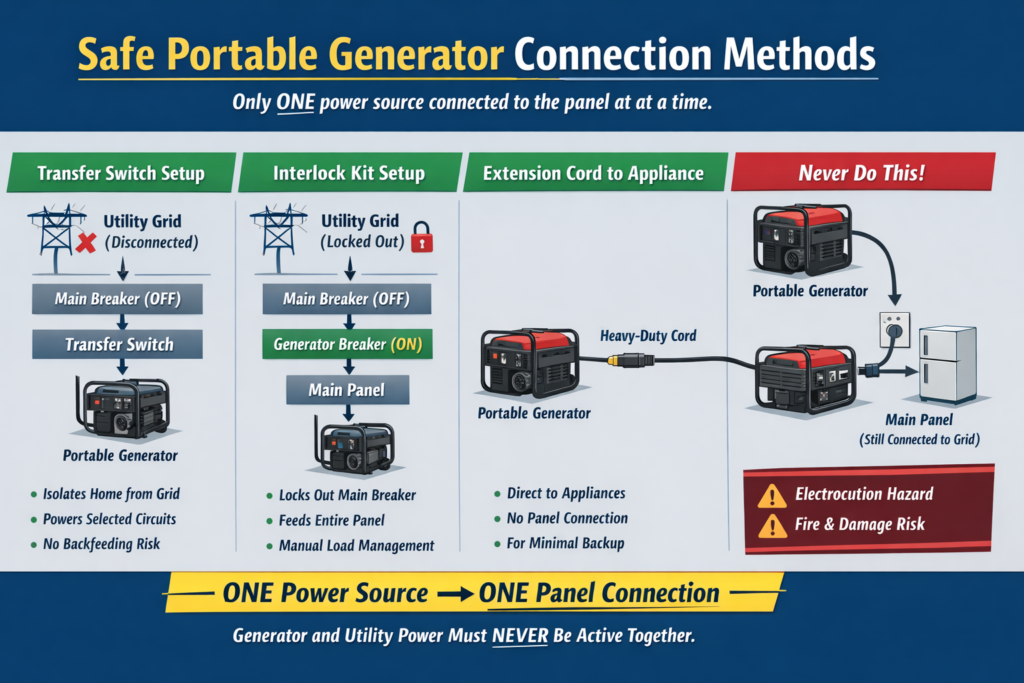
Transfer Switch (Recommended for Most Homes)
A manual transfer switch is one of the safest and most reliable ways to connect a portable generator to your home.
How it works:
• Installed next to your main electrical panel
• Pre-wired to selected essential circuits
• Physically isolates your home from the utility grid
• Allows controlled generator power distribution
Benefits:
• Code-compliant when installed properly
• Safe isolation from grid power
• Clean, organized circuit control
• Ideal for essential circuit backup
A transfer switch is the preferred long-term solution for homeowners who regularly use portable generators.
Interlock Kit (Panel-Based Solution)
An interlock kit is a mechanical device installed on your main breaker panel that prevents the main utility breaker and generator breaker from being on at the same time.
How it works:
• Requires a dedicated generator inlet
• Locks out the main breaker when generator breaker is active
• Prevents dangerous backfeeding
Benefits:
• Often lower cost than a transfer switch
• Uses existing breaker panel
• Allows flexible circuit control
Interlock kits must be installed correctly and may require professional installation depending on local electrical code.
Extension Cord — Direct to Appliance
For short-term or limited backup, you can plug appliances directly into the generator using heavy-duty, outdoor-rated extension cords.
This method:
• Does not connect to your electrical panel
• Avoids backfeeding risk
• Works well for refrigerators, freezers, or sump pumps
Limitations:
• Requires cords running through doors/windows
• Limited appliance flexibility
• Not practical for whole-circuit backup
This approach is safest for temporary, minimal setups.
👉 Link to: Extension Cord Gauge Chart and Calculator
Why Proper Isolation Matters
When utility power is restored, improper generator connection can send power back into the grid. This is called backfeeding, and it is extremely dangerous.
Safe integration ensures:
Load → Generator → Transfer Device → Home Panel (Isolated from Grid)
That isolation step is critical.
👉 Link to: Transfer Switch Guide
👉 Link to: Interlock vs Transfer Switch
👉 Link to: Generator Backfeeding Danger
Maintenance & Reliability
Portable Generator Maintenance Requirements
Portable generators are small engines — and like any engine, they require routine maintenance to remain reliable during an outage. Neglecting maintenance is one of the most common reasons generators fail when they’re needed most.
Portable generators require:
• Regular oil changes — especially during the first 20–30 hours of break-in and at manufacturer-recommended intervals thereafter
• Spark plug inspection and replacement to ensure reliable ignition and smooth engine performance
• Fuel stabilization when storing gasoline to prevent carburetor clogging and fuel degradation
• Periodic test runs (every 1–3 months) to circulate oil, recharge batteries (if electric start), and confirm proper operation
Gasoline left untreated can degrade in as little as 30 days, leading to hard starts or complete failure. Running the generator under load during test cycles also helps ensure voltage stability and proper surge handling.
A portable generator that sits unused for years without maintenance is not a backup plan — it’s a risk.
Routine inspection and proactive maintenance dramatically increase reliability, extend engine life, and ensure your backup system performs when the power goes out.
👉 Link to: Generator Safety Guide
Best Portable Generators (Buyer Guide)
This section can either:
A) Briefly introduce top categories and link to a dedicated buyer guide
OR
B) Include a short comparison table
Better long-term SEO:
Create a separate page:
👉 Link to: Best Portable Generators for Home Backup
For a the Full Guide, visit the complete Home Backup Power Systems Overview.
Portable vs Whole House Generators
Portable vs Whole House Generators (Quick Comparison)
| Feature | Portable Generator | Whole House (Standby) Generator |
|---|---|---|
| Installation | No permanent install required | Professionally installed |
| Startup | Manual start | Automatic start |
| Power Coverage | Essential circuits / selected loads | Entire home (if sized properly) |
| Fuel Type | Gasoline / Propane / Dual Fuel | Natural Gas / Propane |
| Runtime | Limited by refueling | Long-duration (utility-fed or large tank) |
| Noise Level | Moderate to loud | Moderate (enclosed, quieter than open-frame portables) |
| Cost | Lower upfront cost | Higher upfront + installation cost |
| Maintenance | Manual upkeep | Scheduled service intervals |
| Best For | Budget backup, flexibility | Automatic whole-home protection |
Bottom Line
• Choose portable if you want flexible, lower-cost backup and can manage manual operation.
• Choose whole house standby if you want automatic, seamless power restoration with full-home coverage.
👉 Compare Whole House Generators
When a Portable Generator Is Not Enough
Portable generators are highly effective for essential backup power — but they are not the right solution for every home or outage scenario.
There are situations where a portable unit simply cannot meet the electrical demand, convenience expectations, or runtime requirements of the property.
Whole-Home HVAC Systems
Central air conditioning systems, electric furnaces, and heat pumps often require high startup surge and sustained running wattage. Larger 3–5 ton HVAC systems can exceed the practical capacity of most portable generators.
Even if a high-wattage portable unit can technically start the compressor, it may operate near maximum capacity — increasing fuel consumption, engine stress, and breaker trips. Homes that rely heavily on full-house HVAC typically require a properly sized standby generator.
High Simultaneous Load
If multiple high-demand appliances operate at the same time — such as:
• Central air
• Electric water heater
• Well pump
• Refrigerator and freezer
• Electric range or dryer
— the combined load can quickly exceed portable generator capacity.
Portable generators require active load management. If you don’t want to manually rotate appliances on and off, a standby system is often the better long-term solution.
Automatic Startup Requirements
Portable generators require manual setup:
• Move the unit outdoors
• Connect cords or transfer equipment
• Add fuel
• Start the engine
If power loss occurs during severe weather, at night, or while you’re away from home, a portable generator cannot start automatically.
Whole house standby generators activate within seconds of an outage and restore power without homeowner intervention — a major advantage for:
• Homes with medical equipment
• Frequent travelers
• Rental properties
• Elderly occupants
Long-Term or Frequent Outages
Portable generators depend on stored fuel. During extended outages, refueling may become difficult due to fuel shortages, closed stations, or supply chain disruptions.
Standby generators connected to natural gas lines — or large propane tanks — can operate for days or weeks without refueling.
In regions prone to hurricanes, ice storms, or extended grid failures, long-term runtime reliability becomes a critical factor.
The Bottom Line
Portable generators are ideal for essential backup power and short-to-mid duration outages.
But if your home requires:
• Full-house HVAC support
• High simultaneous electrical demand
• Automatic startup capability
• Long-duration outage resilience
— a whole house standby system may be the more appropriate and reliable solution.
👉 Link to Whole House Generators.
A properly sized portable generator for home backup provides essential power during outages while maintaining safety, efficiency, and reliability.
Frequently Asked Questions About Portable Generators
Can a portable generator run central AC?
It depends on the size of both the generator and the air conditioning system. Central AC units have high startup (surge) requirements, especially 3–5 ton systems. A 7,500–10,000+ watt portable generator may run smaller AC units if properly sized and possibly paired with a soft-start device, but many full-size HVAC systems exceed portable capacity. Always calculate both running and starting watts before assuming compatibility.
How long will a 7,500-watt generator run?
Runtime depends on fuel tank size and load percentage. At 50% load, many 7,500-watt gasoline generators run between 8–12 hours on a full tank. At 100% load, runtime drops significantly due to higher fuel consumption. Generators are generally most efficient when operating around 40–60% of rated capacity.
Do I need a transfer switch?
If you plan to connect a portable generator to your home’s breaker panel, yes. A transfer switch (or approved interlock kit) is required to safely isolate your home from the utility grid and prevent dangerous backfeeding. Running extension cords directly to appliances does not require a transfer switch, but connecting to the panel without one is unsafe and often illegal.
Is propane better than gasoline?
Each fuel has trade-offs. Propane burns cleaner and has a much longer shelf life, making it excellent for long-term storage. Gasoline is widely available and often delivers slightly higher power output but degrades more quickly without stabilization. The better option depends on your storage capability, outage expectations, and generator type.
How loud is a portable generator?
Noise levels vary by design. Conventional open-frame generators typically operate between 70–85 decibels (about as loud as a lawn mower). Inverter generators are quieter, often running between 50–65 decibels at moderate loads. Noise decreases with distance, but proper outdoor placement for safety must always come first.
For a the Full Guide, visit the complete Home Backup Power Systems Overview.
Explore More Portable Generator Guides
• 7500 Watt Generator Guide
• Dual Fuel Generator Guide
• Portable Generator Sizing Guide
• Inverter vs conventional Guide
• Best Portable Generators